Model Routing System
A model routing system directs AI requests by complexity, cost, latency, capability, policy, and availability to balance quality and risk.
On this page
A model routing system sends each AI request to the most suitable model instead of sending every request to one default model. It can select models based on task complexity, expected quality, latency, cost, context length, data policy, tool support, or current provider availability.
A company might route a simple classification task to a fast, lower-cost model, send a complex contract analysis to a stronger reasoning model, and move a restricted-data request to an approved regional deployment. Amazon Bedrock provides intelligent prompt routing that predicts response quality between supported models, while Google Vertex AI exposes automatic routing with preferences such as prioritizing quality, balancing quality and cost, or prioritizing cost. (docs.aws.amazon.com)
What is a model routing system?
A model routing system is an operational layer between an application and one or more AI model providers. The application sends a request to the router; the router evaluates the request and selects a model or route; the selected provider returns the response through the same control layer.
The router may be a managed cloud feature, an open-source gateway, or custom software designed around a company’s data, reliability, and approval requirements. LiteLLM, for example, documents a common interface for multiple providers together with retry, fallback, load balancing, spend tracking, and gateway capabilities. (docs.litellm.ai)
The important distinction is that routing is not simply “use the cheapest model.” It is a policy and reliability decision. A useful router knows when a cheaper model is adequate, when a stronger model is required, and when the request should be blocked or escalated instead of sent anywhere.
Why companies use model routing
A single-model architecture is easy to start with but can become expensive, fragile, or difficult to govern as usage grows. Different workflows usually have different requirements:
- High-volume classification: predictable labels, extraction, tagging, or triage.
- Generation: emails, summaries, product descriptions, or internal drafts.
- Reasoning: complex analysis, planning, coding, or multi-step agent work.
- Multimodal work: images, audio, documents, or video inputs.
- Sensitive workloads: requests constrained by region, retention, provider, or contractual policy.
- Resilience: fallback when a provider is unavailable, rate-limited, or returning errors.
A routing layer can also create a stable application interface while model versions change behind it. OpenAI’s Models API, for example, exposes currently available model identifiers and metadata, which is useful for maintaining an explicit model inventory rather than hard-coding assumptions into every application. (platform.openai.com)
The core architecture
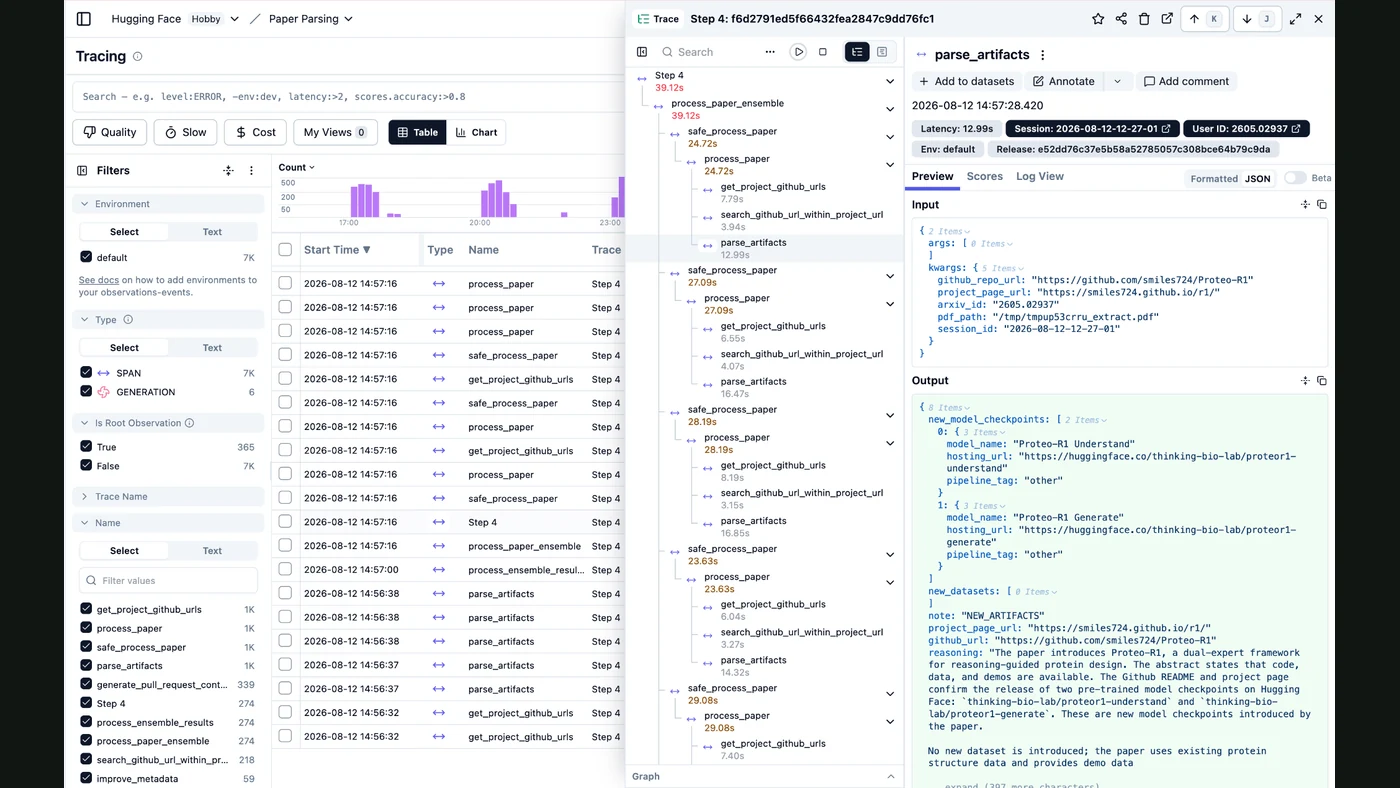
A production routing system normally contains more than a classifier. It combines request inspection, policy enforcement, model selection, provider adapters, observability, and fallback behavior.
The routing decision should be recorded with the request outcome. At minimum, teams need to know which model was selected, why it was selected, whether a fallback occurred, how long the request took, and what it cost.
This connects closely to AI Infrastructure Monitoring and AI System Maintenance, but it is not the same problem. Monitoring tells you whether the system is behaving reliably; routing determines where each request should go in the first place.
Common routing strategies
There is no universal routing strategy. Most production systems combine several of the following methods.
| Strategy | Decision signal | Good fit | Main limitation |
|---|---|---|---|
| Static rules | Task type, tenant, region, model capability | Regulated or predictable workflows | Requires ongoing rule maintenance |
| Complexity routing | Prompt length, tool count, reasoning class, input type | Mixed workloads with clear complexity bands | Heuristics can misclassify unusual requests |
| Quality-based routing | Predicted or measured response quality | Balancing quality and spend | Requires evaluation data and careful thresholds |
| Load balancing | Provider capacity, quotas, latency, health | High availability and bursty traffic | Does not guarantee the best response |
| Fallback routing | Timeout, error, rate limit, failed validation | Resilience and continuity | Fallback may increase cost or alter output behavior |
| Human approval routing | Risk score, action type, confidence | Agents that can change records or send messages | Adds delay and operational review work |
Managed services already expose some of these patterns. Amazon Bedrock’s intelligent prompt routing uses a fallback model and a configurable response-quality difference when determining whether to switch to another model; its documentation also notes that routing is optimized for English prompts and may not be optimal for specialized use cases. (docs.aws.amazon.com) Google Vertex AI documents both automatic and manual routing modes, with automatic preferences for quality, balanced quality and cost, or cost. (cloud.google.com)
A practical routing policy
A useful first version should be understandable by operators. Start with explicit policies before introducing a learned router.
if data_policy forbids provider_a:
    use approved_provider_b
elif task == "structured_extraction" and schema_is_simple:
    use fast_model
elif task in ["complex_reasoning", "code_generation"]:
    use reasoning_model
elif latency_budget < 2 seconds:
    use low_latency_model
else:
    use default_model

if provider_error or timeout:
    retry_once_with_backoff()
    if still_failed:
        use approved_fallback()
This policy should be paired with validation. For structured output, the router should not treat a successful HTTP response as a successful business result. It should validate the schema, required fields, citations, tool parameters, or safety conditions before returning the result.
For agents, routing can happen at multiple stages. The planning step may need a stronger model, while repetitive tool-result summarization may use a smaller one. However, changing models mid-run can affect instruction following, tool syntax, context handling, and output consistency. The routing contract must therefore specify which stages may switch models and which stages must remain pinned.
Setup: how to build one
1. Inventory the workloads
List every AI call by workflow, not only by application. Record the task, input type, expected output, context size, tool requirements, latency target, risk level, and whether a human must approve the result.
2. Define the approved model catalog
For each model, store capability, provider, region, supported modalities, context limits, pricing inputs, rate limits, data controls, and lifecycle status. Do not assume that a model name remains available indefinitely; provider catalogs and model versions change.
3. Create a routing contract
The contract should define the request schema, response schema, timeout behavior, retry policy, fallback order, trace fields, and error taxonomy. Applications should call the routing contract rather than embedding provider-specific logic in every workflow.
4. Build an evaluation set
Use representative prompts from real workflow categories, including difficult and ambiguous cases. Compare candidate models on task-specific quality, not only generic benchmark scores. Amazon Bedrock recommends reviewing performance and cost metrics regularly when operating intelligent prompt routers. (docs.aws.amazon.com)
5. Launch in shadow or controlled mode
Initially, keep the existing model as the production path while the router evaluates alternatives in the background where policy permits. Then enable routing for low-risk workloads, keeping high-risk actions pinned or approval-gated.
6. Monitor and revise
Track routing share, provider errors, latency percentiles, token usage, estimated cost, validation failures, fallback rate, user corrections, and quality review results. A router that lowers spend but increases rework is not performing its intended job.
Cost drivers and limitations
The cost of a model routing system is not limited to model tokens. Important cost drivers include:
- Model input and output usage.
- Router or gateway hosting and observability infrastructure.
- Evaluation runs and shadow traffic.
- Additional retries, fallbacks, and parallel calls.
- Prompt classification or quality prediction calls.
- Engineering work to maintain provider adapters and model catalogs.
- Human review for uncertain or high-impact actions.
Routing can reduce unnecessary use of expensive models, but it can also increase total cost if every request is classified by another model, retried aggressively, or sent to multiple candidates. Cost should therefore be measured per completed business outcome, not only per API call.
The main limitations are operational. A router may misjudge an unusual request, quality can vary across providers, model behavior can change after a version update, and a fallback model may produce a different format or level of detail. Managed routing services also have scope constraints. For example, Amazon Bedrock’s intelligent prompt routing is limited to supported model families and documents that it cannot adapt its decisions using application-specific performance data. (docs.aws.amazon.com)
Failure modes to design for
Wrong model selection: A simple classifier may mistake a short but high-risk request for an easy task. Add policy overrides for regulated, financial, security, or externally visible actions.
Silent fallback drift: A provider outage can cause the system to use a weaker model for hours without anyone noticing. Emit a visible fallback metric and alert on abnormal routing share.
Schema incompatibility: Different models may interpret tool calls or structured output differently. Normalize responses and validate before downstream actions.
Context loss: A fallback path may not support the same context length, modalities, or cached context. Define truncation and refusal behavior explicitly.
Provider lock-in: A gateway can reduce application coupling, but provider-specific features still create dependencies. Keep adapters and capability metadata separate from business logic.
Uncontrolled experimentation: Automatically adding new models to production routing can change cost, behavior, or data handling. Require approval for catalog and policy changes.
When is a model routing system suitable?
Use one when the business has multiple AI workloads, meaningful differences in model capability or price, more than one provider or deployment, or a real need for availability and policy controls.
A router may be unnecessary when there is one low-volume workflow, one approved model, stable traffic, and no material benefit from fallback or cost optimization. In that case, a direct provider integration with clear monitoring is simpler.
Readiness checklist
What FollowAI can build
FollowAI can design, code, connect, launch, operate, monitor, and improve a model routing system as part of your production AI infrastructure. The deliverable can include a central model gateway, provider adapters, model and capability registry, routing policies, structured-output validation, retry and fallback handling, cost attribution, trace logging, dashboards, alerts, and deployment controls.
For an agent or workflow system, FollowAI can connect the router to your application APIs, CRM, knowledge base, queues, identity layer, and observability stack. Continuous steps can include request classification, policy checks, model selection, provider execution, retries, fallback, usage logging, and health monitoring. Optional or required approval can remain for model catalog changes, policy changes, sensitive data routes, and external actions.
This complements AI Access Control, which governs who or what may act, and AI Agent Development, which covers the agents using the infrastructure. The result is one connected operating system rather than separate provider integrations, monitoring work, and automation contractors coordinated manually.
A model routing system is worthwhile when model choice has become an operational decision. Built correctly, it gives the business a controlled way to balance quality, cost, latency, resilience, and policy without rewriting every AI workflow whenever a provider or model changes.
Continue through the Knowledge architecture
- Custom CRM Development for Real Business Processes
- Corporate AI Knowledge Base: Governed Answers from Company Sources
- AI Content and SEO System: A Governed Research-to-Measurement Workflow
Sources
- Amazon Bedrock: Intelligent prompt routingOfficial documentation
- Google Cloud Vertex AI: RoutingConfigOfficial documentation
- Google Cloud Vertex AI: Generative AI documentationOfficial documentation
- OpenAI API: Models referenceOfficial documentation
- LiteLLM documentationOfficial documentation