LLM Cost Optimization: Control Token Spend in Production
Reduce LLM operating cost without degrading business outcomes through measurement, model routing, caching, batching, budgets, and production controls.
On this page
LLM cost optimization is the disciplined reduction of model spend while preserving the quality, latency, safety, and business result a workflow requires. A company uses it to control token usage across chatbots, agents, document workflows, and internal copilots. A recognizable example is a support system that uses a lower-cost model to classify every ticket, retrieves only the relevant policy excerpt, and sends complex or high-risk cases to a stronger model for resolution.
The goal is not to use the cheapest model everywhere. It is to build a system that spends more only when the additional reasoning, context, or reliability creates enough value.
What drives LLM cost?
Most production bills are shaped by five variables:
| Cost driver | What increases spend | Control mechanism |
|---|---|---|
| Input tokens | Long system prompts, repeated documents, full conversation history | Trim context, summarize history, cache stable prefixes |
| Output tokens | Unbounded answers, verbose JSON, unnecessary reasoning | Set output limits, enforce schemas, ask for concise outputs |
| Model choice | Sending simple tasks to expensive models | Route by task complexity and risk |
| Request volume | Retries, duplicate calls, polling, agent loops | Idempotency, deduplication, loop budgets, backoff |
| Extra capabilities | Search, tools, audio, vision, storage, grounding, embeddings | Measure each component separately and apply usage policies |
Pricing changes frequently and differs by model, modality, service tier, and provider. Use the current provider pricing page as the source of truth before approving a deployment. OpenAI publishes separate API pricing and batch-processing documentation, while Google documents standard, batch, caching, and service-tier prices on its Gemini pricing page. (platform.openai.com)
Start with a cost model, not a cheaper model
Before changing prompts or providers, create a cost ledger for each workflow. At minimum, record:
- workflow and environment;
- provider and model;
- request count;
- input tokens and output tokens;
- cached input tokens, where available;
- tool, search, embedding, audio, or image charges;
- retries and failed calls;
- latency and success rate;
- human escalations;
- business outcome, such as resolved tickets, approved documents, or qualified leads.
A simple estimate is:
monthly model cost =
(requests Г— average input tokens Г— input price)
+ (requests Г— average output tokens Г— output price)
+ tool and storage charges
+ retry and fallback cost
That estimate is useful, but it is not the complete unit economics. If a cheaper model produces more rework, escalations, or failed automations, the apparent saving may disappear. Track cost per successful outcome as well as cost per request.
- Measure actual usage and outcome quality.
- Remove unnecessary context and duplicate calls.
- Route simple work to efficient models.
- Cache stable context and batch non-urgent work.
- Set budgets, alerts, and approval thresholds.
- Review quality regressions before expanding the policy.
The highest-value optimization levers
1. Route by task complexity
Use a model policy rather than one model for every request. A practical routing tree might look like this:
| Request type | Default path | Escalation condition |
|---|---|---|
| Classification, extraction, tagging | Efficient model with structured output | Low confidence or schema failure |
| FAQ response from approved content | Efficient model plus retrieval | Missing evidence or policy ambiguity |
| Multi-step planning | Stronger reasoning model | Required tools fail or plan is incomplete |
| Legal, financial, security, or customer-impacting action | Strong model with approval gate | Human approval required before execution |
| Bulk summarization or enrichment | Batch processing | Deadline or quality threshold is missed |
Routing should be based on observable signals: task type, document length, confidence, risk class, number of tools required, and prior failure history. Do not route solely on the user’s wording or on model self-confidence, which can be poorly calibrated.
2. Reduce input tokens without destroying context
Long prompts are often the largest avoidable cost. Common improvements include:
- move stable instructions into a reusable prefix;
- remove duplicated policy text from each agent step;
- retrieve a small set of relevant passages instead of attaching an entire knowledge base;
- summarize older conversation turns;
- pass structured fields instead of repeated prose;
- strip HTML, navigation, boilerplate, and irrelevant metadata before indexing;
- keep tool results compact and request only needed fields.
Compression has a failure mode: an over-aggressive summary can remove the qualification, exception, or approval condition that makes an answer safe. Preserve source references and allow the workflow to retrieve the original evidence when a decision depends on it.
3. Use prompt or context caching deliberately
Caching is valuable when many requests reuse a large, stable prefix: system instructions, product documentation, a policy library, or a code repository. Google documents explicit context caching for the Gemini API, including cache creation, reuse, expiration, and storage considerations. Provider behavior and eligibility vary by API and model, so the implementation should follow the current documentation for the exact endpoint in use. (ai.google.dev)
Caching is not automatically cheaper. Model-specific minimums, cache lifetime, storage charges, changing prefixes, and low reuse rates can reduce or eliminate the benefit. Measure cache-hit rate and cached-token cost. Keep stable content at the beginning of the prompt where the provider’s caching rules expect a reusable prefix.
4. Batch work that does not need an immediate answer
Batch APIs are designed for asynchronous workloads such as nightly classification, document enrichment, evaluation runs, report generation, and embedding jobs. OpenAI documents a 24-hour batch window with a 50% discount for supported batch requests. Google likewise documents batch processing at 50% of the equivalent interactive API cost, with jobs designed around a 24-hour turnaround. (platform.openai.com)
Batch is unsuitable for live support, interactive sales conversations, or any workflow where a delayed response creates operational risk. Design the job with reconciliation: every input needs a stable identifier, every output needs a status, and failures need a retry or exception queue.
5. Control agent loops and retries
Agentic workflows can spend more through repeated planning, tool calls, retries, and context growth than through the final answer. Add explicit controls:
- maximum steps per task;
- maximum spend per request and per workflow;
- maximum tool retries;
- timeouts and exponential backoff;
- duplicate-call detection;
- circuit breakers for failing providers;
- fallback models with documented quality limits;
- human approval before irreversible actions.
A loop budget should be visible in logs. When a task reaches its limit, the system should stop, preserve its state, and escalate or request clarification rather than silently continuing.
What an LLM cost-control system should monitor
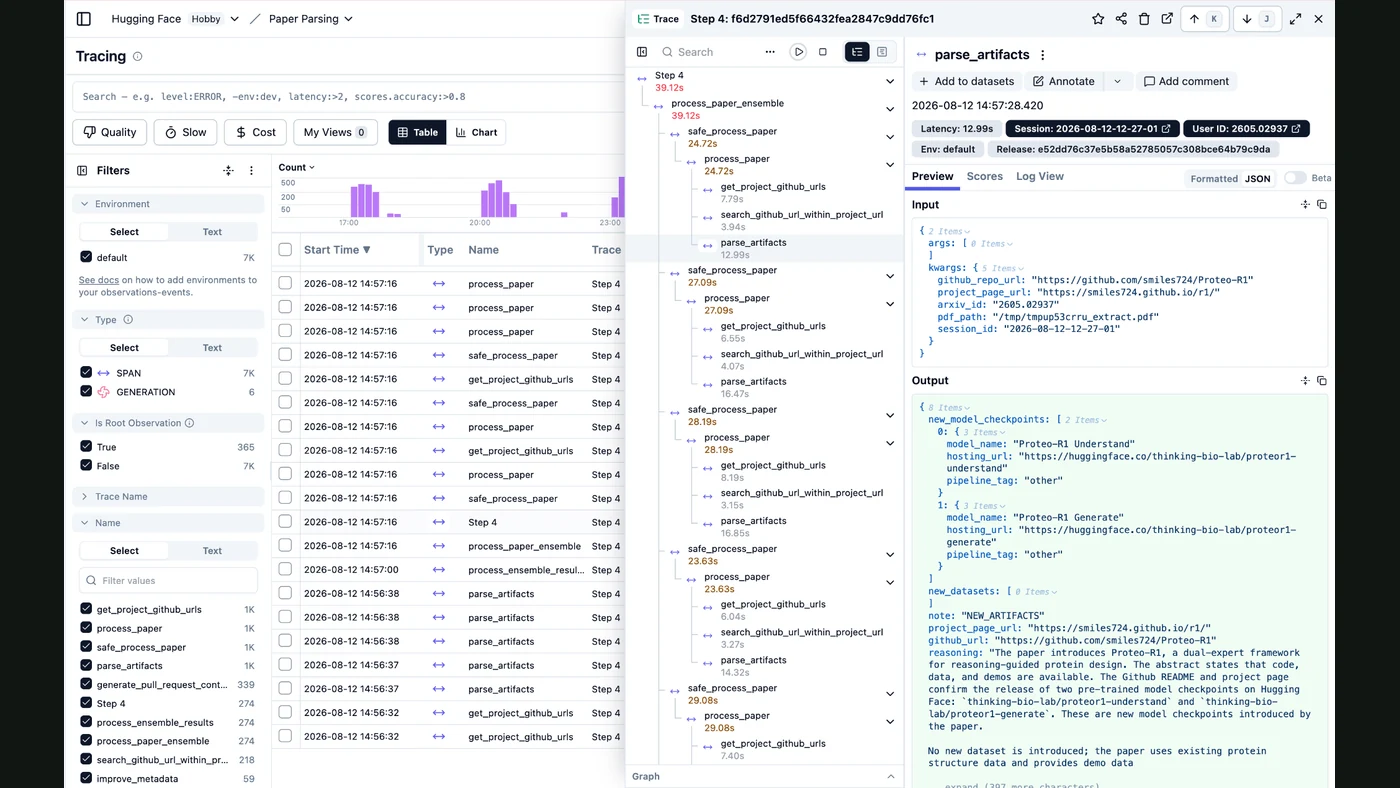
A production dashboard should show more than a monthly provider invoice:
| Metric | Why it matters |
|---|---|
| Cost by workflow | Identifies the expensive business process |
| Cost per successful outcome | Connects spend to value |
| Input/output token mix | Shows whether prompts or answers are bloated |
| Cache-hit rate | Tests whether caching is working |
| Retry and fallback rate | Reveals reliability-driven cost |
| Average and p95 latency | Prevents cost changes from damaging service |
| Quality score or evaluator pass rate | Detects degradation after routing changes |
| Budget utilization | Provides early warning before an overrun |
Provider retention and data controls also matter. For example, OpenAI documents that abuse-monitoring logs may contain customer content and are retained by default for up to 30 days, while some API features store application state for their operation. Cost optimization should therefore be reviewed alongside security, retention, and residency requirements—not treated as a purely financial exercise. (platform.openai.com)
A practical implementation pattern
- Classify the request. Identify task type, risk, urgency, context size, and required tools.
- Apply the policy. Select an allowed provider, model, service tier, token budget, and approval rule.
- Prepare context. Deduplicate, retrieve relevant evidence, summarize history, and use a cache where reuse is high.
- Execute with limits. Enforce timeout, retry, tool, and spend budgets.
- Validate the result. Check schema, citations, confidence signals, policy constraints, and business rules.
- Record the outcome. Store token usage, cache status, latency, errors, quality results, and human intervention.
- Review exceptions. Improve routing and prompts from real failures rather than optimizing only average cost.
Failure modes to avoid
- Cheapest-model bias: cost falls while accuracy, resolution rate, or compliance worsens.
- Prompt compression without evaluation: important exceptions disappear from the context.
- Caching sensitive or volatile content: stale or improperly retained information is reused.
- Batching urgent work: the workflow saves money but misses the required service window.
- Unbounded fallbacks: a failed request silently triggers several expensive models.
- No tenant-level budgets: one customer, team, or agent can consume the shared allowance.
- Invoice-only monitoring: finance sees the total, but engineering cannot locate the cause.
- Provider lock-in without an abstraction layer: changing models requires rewriting every workflow.
LLM cost optimization checklist
- Every production call has a workflow, tenant, and environment label.
- Input, output, cached, tool, and retry costs are separated.
- Each workflow has a quality measure and a cost-per-outcome measure.
- Simple tasks use an efficient model by default.
- High-risk actions have explicit approval rules.
- Agent steps, retries, tool calls, and spend have hard limits.
- Stable repeated context is tested for caching economics.
- Non-urgent bulk work is considered for batch processing.
- Alerts exist for abnormal volume, cost, latency, and failure rates.
- Provider pricing, retention, and model changes are reviewed regularly.
What FollowAI can build
FollowAI can design, code, connect, launch, operate, monitor, and improve an LLM cost-control layer around your existing AI workflows. The deployed system can connect model providers, application logs, CRM or ticketing systems, data stores, approval tools, and finance reporting into one operating view.
A complete build can include:
- a usage ledger that attributes tokens and tool charges to workflows, teams, tenants, and outcomes;
- model-routing rules for classification, retrieval, generation, reasoning, and high-risk actions;
- prompt and context preparation that removes duplication and manages conversation history;
- cache-aware request handling and cache-hit monitoring;
- batch queues for eligible asynchronous work;
- per-request, per-workflow, and per-tenant budgets;
- retry, timeout, fallback, and circuit-breaker controls;
- quality evaluation and regression alerts when a cheaper route produces weaker results;
- dashboards for spend, latency, reliability, cache performance, and business outcomes;
- approval queues for actions that can change records, contact customers, move money, or affect compliance.
The continuous workflow can classify requests, choose an approved route, enforce budgets, record usage, detect anomalies, and escalate exceptions. Human approval can remain required for sensitive actions or for changes to routing policies. Within a defined scope, this consolidates coordination across infrastructure, automation, observability, and integration work into one connected system that is built and operated against the actual workflow.
For a business already running multiple agents or AI automations, the natural next step is a deployed LLM FinOps and AI operations system: provider connections, routing, budgets, observability, approval controls, and continuous improvement in one production service.
Continue through the Knowledge architecture
- Custom CRM Development for Real Business Processes
- Model Routing System
- AI Observability Dashboard
Sources
- OpenAI API Batches referenceOfficial documentation
- OpenAI API pricingOfficial documentation
- OpenAI platform data controlsOfficial documentation
- Google Gemini API pricingOfficial documentation
- Google Gemini context cachingOfficial documentation
- Google Gemini Batch APIOfficial documentation